
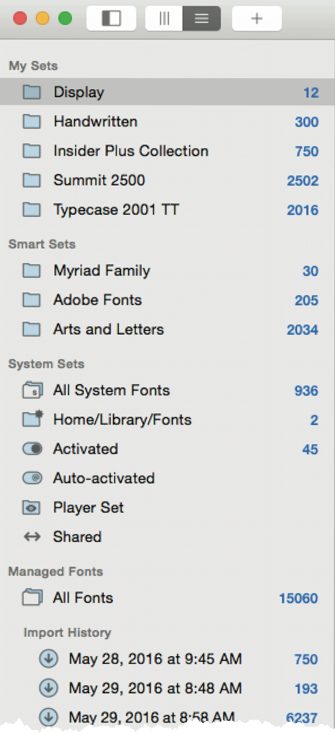
Sets are logical groupings of your fonts that you can use to organize your fonts based on customer, project, font style, foundry, or anything else that helps your workflow. Sets are handy because you can activate, deactivate or share all the fonts in a set with a single click or command.
Important Tips About FontAgent Sets
- FontAgent® automatically creates Import History sets for you as you import new fonts.
- You can create and delete sets without removing the fonts they contain from your FontAgent database.
- To add and remove fonts from sets, simply drag the fonts into and out of the sets.
- FontAgent also automatically maintains Defined Sets that are related to FontAgent operations.
- You can also create Smart Sets, which automatically include fonts based on criteria you specify.
- You can reverse an import request by deleting the associated Import History set.
Create a New Empty Set
You can create sets at any time to group your fonts in meaningful ways. If you create lots of sets, FontAgent scrolls the list of sets that appear in the left sidebar. To create a new set, follow these steps:
- Right-click the Sets entry in the Sets Sidebar and select New Set from the pop-up menu.
- A dialog appears and prompts you to name the new set.
- Enter the name and click Save.

Using Nested, Hierarchical Subsets
FontAgent lets you define subsets as children of top-level sets. Here are some ideas for using subsets to simplify your Sets Sidebar:
- Alphabetic sets with family subsets
- Design client sets with project subsets
- Print customer sets with job number subsets
- Foundry sets with family subsets
- Classification sets with family subsets
- Classification sets with alphabetic subsets
Once you have created your parent and child sets, you can use disclosure triangles on the parent sets to hide the child sets as you wish.
Create a New Subset (Nested Set)
You can create subsets (nested sets) to organize your fonts into subcategories, such as organizing fonts for different projects for a client. To create a nested set, follow these steps:
- Select a set from the Sets Sidebar.
- Right-click the Sets entry in the Sets Sidebar and select New Subset from the pop-up menu
You can also drag an existing set onto another set to make the selected set a subset of the target set.
Create a Set Containing Selected Fonts
To create a new set containing a group of fonts you have selected, follow these steps:
- Use Shift-click or Ctrl-click to select the fonts you want in the new set.
- Select the Set > From Selection menu command.
- Name the set and click Save.
Add Fonts to Sets
To add fonts to an existing set, drag the fonts onto the set’s name in the Sets Sidebar in the left column.
Remove Fonts from Sets
To remove fonts from an existing set, select the fonts you wish to remove, right-click the selected fonts and select Remove From Set from the pop-up menu. When you remove a font from a set, it still resides in your FontAgent catalog.
Rename Sets
To change the name of a set, you can either:
- Double-click the set’s name, rename the set, and press the Enter key.
- Right-click the set’s name, select Edit from the pop-up menu and FontAgent displays a Set Name dialog. Type the new name for the set, and press Enter.
Delete Sets
To delete a FontAgent set, right-click its entry in the Sets Sidebar and select the Delete command from the pop-up menu.
Using Defined Sets
As you add fonts to your catalog, FontAgent® maintains a group of Defined Sets automatically. The special sets are predefined by FontAgent and you can select them just like you select any other set.
Using Import History Sets
When you import fonts into FontAgent, it automatically creates a set in your Import History so you can find your new fonts easily. To make it easy to manage your font catalog, if you delete an Import History set, you delete the fonts it contains from your FontAgent catalog.
When you delete a named set, you delete only the logical association of fonts, not the actual font files contained in the set. But when you delete an Import History set, you delete the fonts it contains from your FontAgent catalog.